top of page
CASE STUDY


HOW DO PEOPLE FIND NEW MUSIC?
Why do people prefer one music platform over another ?
This study was conducted by me and my five teammates as part of Foundations of Human Computer and Interaction coursework at RIT between October 2019 and December 2019.
RESEARCH PROBLEM
Music streaming services are heavily popular today and there is no shortage of platforms from which to choose. To understand user preferences and usage of these different applications, each one of us conducted initial field observations. This process helped us identify a key research question -
How do people discover New Music on their preferred music streaming application and what motivates people to use one platform over another?
Case Study:Top
PROCESS
Initial field observations
Identifying key research question
Data Collection
Creating User Profiles and Persona Building
Building Scenarios and Storyboarding
METHODOLOGY
-
Contextual Enquiry
After initial observations, few questions were asked to the subjects based on the observations. For data collection we used contextual enquiry to ask semi structured questions followed by task-walkthrough session.
-
Persona Building
We summarized the data collected, in a user profile table and created personas to represent our subjects.
-
Storyboarding
Based on personas and identified issues, we built a Problem scenario and a Design scenario. We then used storyboarding to visually represent these scenarios.
TOOLS
-
Pen, Paper, Google documents for taking notes and summarizing observations.
-
Google Slides and Adobe XD for creating and editing Personas
-
Adobe Illustrator and GoodNotes for building storyboards

"My friends recommend me new songs."
WHAT PEOPLE HAD TO SAY...
"I use YouTube to find new songs if I don't find it in the app I use, because it is easy to find mashups too!"
"I can find a new song I have never heard before using Shazam; it is cool that Spotify is compatible with Shazam."
"If I can afford someday, I will buy subscription for Apple Music since it has latest music."
"I don't like to make my playlist, I would like the app to generate it for me."
"I like Spotify, it is easy to use, has good recommendation system. I especially like the dark interface."
To know more about my Data Collection process and its results, check the link below
INDIVIDUAL OBSERVATIONS
This user table represents the data collected by each of us from our interviews

USER PROFILES
We grouped the collected information to create a User Profile Table.

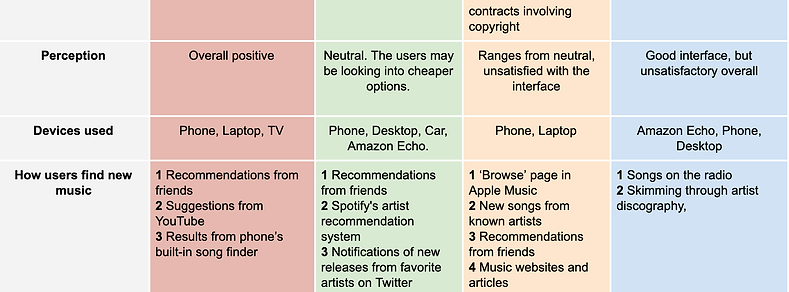
USER PERSONAS

Persona 1

Persona 2

Persona 6
Persona 1
1/6
STORYBOARDING
Our scenarios and storyboards are based on Persona 5 named Ethan Immanuel.
PROBLEM SCENARIO
Luka and I met freshman year of college at a local concert, and we have been friends ever since. We still go to local shows together and often get into conversations about music. We also constantly share recommendations. Currently, all the music recommendations Luka and my other friends have given me are scattered across old texts, faint memories and a master list of songs I keep on the Notes app. When I get home from work, I love to unwind by listening to music and enjoying the art in my home, but listening to the same thing repeatedly can get a little annoying, so I depend on recommendations from Luka and other friends.
It is hard to keep track of the recommended music that I have already explored, and it is very tedious to scroll through old texts trying to find the name of the song. At times, I also forget the names of songs that have been recommended to me in passing. Sometimes I am in a hurry when writing down the name of a song, or Luka might not really be paying attention, so we don't notice when Autocorrect modifies a song or artist name. Luka is also a particularly irregular texter, so sometimes he does not respond for hours when I message him to clarify the name of the song he recommended a while ago or even when I am simply asking for new music recommendations.
We both use Spotify to maintain our music libraries and find new music. I wish there was some way for us and our extended group of friends to easily share music. It would save me the time I lose having to ask and wait for a response or scrolling through old text conversations trying to find artists we talked about weeks ago.

DESIGN SCENARIO
I do not watch television or read often, and I mostly listen to music when I am trying to relax at home. I am usually very tired after work, so I typically just heat up some leftovers, pair my phone with my speakers, and admire my replica of Cezanne's Le Lac d' Annecy while sitting on my couch. When I get tired of listening to the same songs, I send a request to my best friend Luka, who has similar music tastes, and ask him to recommend a song or playlist to me.
Sometimes he sends me in-app song recommendations without my having to ask. When Luka recommends a new song to me, a Spotify notification appears on my home screen. I tap on it, and Spotify auto-navigates to my Recommendations library. It is really convenient, because I do not have to leave the app. Also, Luka makes a lot of typographical errors , so this prevents the need to go back and forth on the spelling of the song, aritist, or playlist. When he is busy or his Spotify profile indicates that he is offline, I navigate to my Recommendations library and check out the songs or playlists that have been recommended to me, but which I have not listened to yet. It is very convenient that Spotify indicates that I have not listened to a song in the Recommendations library by putting a little green circle next to it.
If I do not like a song or playlist, I remove it from my Recommendations library, but that action can be undone at any time. I also like that I am able to filter the library by recommender, as it will make it easy to delete all the recommendations from my partner when I break up with them this evening.


FUTURE SCOPE
User preference for a certain music streaming service depends on number of factors- Cost and compelling deals, ease of use, availability of latest music and most importantly the ability to discover new music effortlessly.
This study, if extended to a larger population, can serve as a cornerstone to develop a model to determine the likelihood of a user switching to a new streaming service depending on patterns of use.
bottom of page